What are bodies for?
It’s not as obvious a question as it might seem. They’re for using, I suppose. I use mine daily. They bring us (if “they” aren’t “us” straightforwardly) a lot of pleasure and plenty of pain. The delicious dinner I just enjoyed gives a lot of the former. Aches and pains of the trivial sort remind us of the shadow side of being embodied creatures, and the depth of physical pains some folks have to endure is enough to press the opening question into a different register: What are bodies for??
A basic Christian affirmation is that embodied life is good, as such. It’s part of what God intended for humans. And not just as a means to maximize the pleasure. The limits imposed by our having bodies are not obstacles to be overcome or even grudgingly accepted in the fate of a less-likely-to-be-realized Gnostic dream of disembodiment. Bodies are finite in space, and they’re finite in time, by which I mean we all die. Such limitations are important contributors to what makes our lives meaningful.
Such sentiments are awfully abstract. Let me describe an example, and then come back around to re-make my earlier point in a slightly different way.
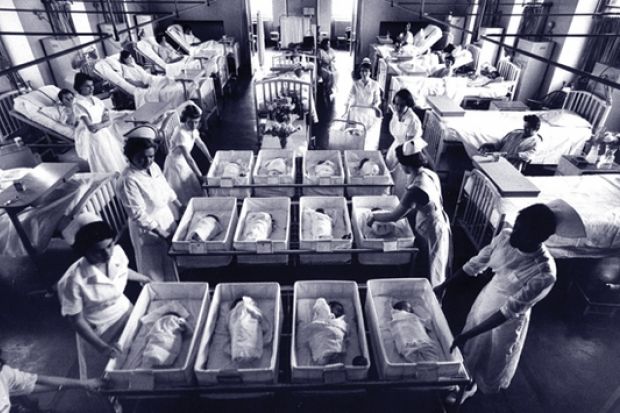
One of the ways we can see how bodies, and their limits, matter is to look at babies. There were many, many orphans during World War I and World War II. Many were just newborns. Doctors in Europe were starting, by the end of WWI, to be much better record keepers of what treatments worked and what didn’t. They also more carefully differentiated between young people’s health and adult health. Here’s one thing that medical professionals noticed: even when standards of hygiene, nutrition and comfort were high, infant mortality could be shockingly high, and physical and social development profoundly stunted.
I’m oversimplifying a complex and fascinating story, but the problem seemed to be that medical staff were treating babies like machines. Babies needed to be kept within a certain temperature range, they needed to have their diapers and bedclothes changed at regular intervals, they needed to be supplied with a certain amount of nutrition, and so on. What’s more, to reduce the possibility of spreading germs and cross-contamination of vulnerable populations, babies were kept quite separate from each other and from other caregivers.
And they died, in huge numbers. Or developed slowly, or did not develop at all. The only difference researchers could see between these babies and the wider population was that they were being kept in a hospital until they could be adopted or raised elsewhere. That gave rise to the name for this condition: “hospitalism.” The term is still in use but it came to mean something else. Today we might speak of this condition in babies as “failure to thrive.”
To cut to the chase, the difference wasn’t actually the hospital: it’s that the infants weren’t held. I can be a sappy guy once in a while, so it’s tempting to say “Aww, they just needed love.” That might be so, but there’s something else about it. When you’re held lovingly, you feel safe, and when you’re safe you can process things. One of the things you’re processing when you’re safe and being lovingly held is, “Oh, that’s my body, and that’s her body.” “I’m being hugged. That’s nice and warm, I like that.” The infant comes to know his body as something that extends into space and then stops. It reaches its limit. The distance and contour of that limit is processed by the brain as being that which is the site of loving touch, of safety, of the one taking care of them. Hugging an infant’s 14 pound body helps them know the goodness and integrity of those 14 pounds. Babies in European war hospitals were touched four times a day, perhaps, but their bodies weren’t held.
To change the example slightly (though as this article suggests, there could well be close connections), we could consider a couple features of neuroprocessing difficulties that those on the autism spectrum face. One symptom of autism is a dislike of too much of their body being touched. They might walk on tiptoes to reduce how much of their foot is in contact with their shoe and with the ground. Some recoil at being touched by someone they don’t know or trust. (I hasten to add that “touch aversion” is only one part of the mysterious conditions of autism; some with autism crave even more touch to constantly shape and solidify their “touchscape.”). For a variety of reasons, they don’t associate the caress of the edge of their bodies with pleasure or comfort. It makes it hard for others to know how to show love, and causes a host of problems for the autistic child, as well. Some therapies seek to reverse this. The use of weighted blankets, a bit like those used in dentists’ offices to block X-ray radiation, for instance, can help reinforce “your body ends here. You can feel safe because the border between your body and the outside world is right here.” A similar case can be made about the effectiveness of massage therapies as a way of integrating sensory processing and making the limit between “this is my body” and “this isn’t my body anymore” more reliable and trustworthy in the person receiving the therapy.
Let’s come back now to the original point. Gnostics in the early church, who may well have outnumbered the “orthodox,” were trying to say that bodies are the problem. God is a spiritual being, who wants to gather spirits into heaven to commune with them spiritually, they argued. Some Gnostics were then libertines with things of the body (do what you want with your body, since it’s not really “you” anyway), while others were extremely ascetic and disciplined (we should fight against the base desires of our body in order to focus on what our spirits really want).
Early Christian doctrines like the Incarnation and the goodness of Creation were forged in the face of these Gnostic challenges. Did Jesus have a body like yours and mine? Yes! Is the goodness of the creation described in Genesis 1 to be affirmed as Christian Scripture, too? Yes!
The limits that our physical bodies impose can sometimes be experienced as hardship or distraction. But they are also vital ways of deepening our appreciation of where we end where our beloved begins. Those limits give us a site to experience the pleasure of touch, the joy of being held in love. We must not wish them away, but instead find ways to rest secure in the knowledge that they are there, must be there and that God wills them for our flourishing.