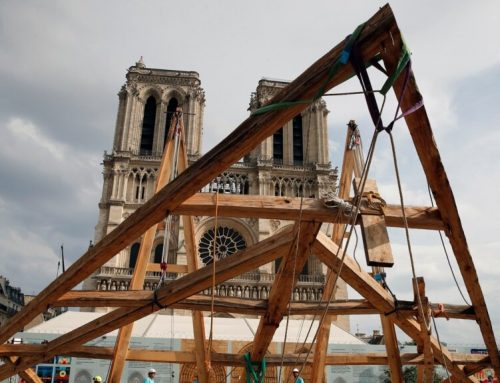
In this series I have been trying to show how, quite without any nefarious intentions, anti-body assumptions have worked their way into our contemporary experience. Intentionally eclectic to show the many dimensions of how this “gnostic” set of assumptions have creeped into our lives, past installments looked at child raising, sports refereeing and bureaucracy. It would be easy to expand this line of thinking indefinitely in other directions, such as our estranged relationship to food sources, protection from elements of weather and exposure, and a host of other technologically-mediated experiences.
At the risk of becoming too much like another Hoosier woodworker, Ron Swanson (who my wife tells me is my Spirit Animal), this post will actually be a screed against the metric system. There is no lack of such material on the internet, surely. And commentary on weights and measures probably hit its all-time peak with Nate Bargatze’s cold-open on Saturday Night Live this year, a clip featuring George Washington defending imperial yards, miles and ounces that was viewed over 10 million times within days of being recorded.
But I don’t want to debate about ease of use (I tend to prefer fractions to decimals) or utility in scientific contexts (a clear winner for the metric system!). Instead I would like to reflect on the ways in which measurements used in daily life used to be quite straightforwardly indexed to human bodies, until quite suddenly they were not.
As a first example, let’s look at liquid measures. The seltzer water on my desk is 355 mL. I’m trying to drink less pop these days, which means my 2 liter bottles of coke go flat before I drink them. Since I know about how big a centimeter is, and one cubic centimeter is one milliliter, I can kind of intuit those numbers as referring to actual sizes with which I am familiar. But this is not nearly as intuitive, and certainly not as “embodied” a way of knowing and dealing with the material world than is the “imperial” system, which uses doubling, rather than factors of ten, to go from one measurement to another. By the end of the sixteenth century in England, an embodied system of measurement went from one “mouthful” to one “tun.” A mouthful is about one cubic inch. But it’s also just, um, a mouthful of liquid. Here’s how the doubling worked:
Two mouthfuls: one jigger
Two jiggers: one jack
Two jacks: one jill (or sometimes “gill”)
Two jills: one cup
Two cups: one pint
Two pints: one quart
Two quarts: one pottle
Two pottles: one gallon
Two gallons: one pail
Then the wheels kind of fall off and you have casks, pipes, butts, rundlets, tierces, barrels, kegs, and hogsheads in some series of sizes until you get to a tun. The differences were dependent partly on geography and local custom, but also on what was being measured. A tun (or tonne, now “ton” in American English) functioned as a weight as well as measure of volume. So you would want more mouthfuls of a less dense liquid like wine in a ton than of a denser liquid like olive oil, if the system were to remain intuitive and body-centered. The variability such a system was required to accept opened the way to malfeasance, too. A “baker’s dozen” is a way for a baker to make sure he won’t be punished for selling twelve of something that didn’t hit a specified minimum weight. The childhood rhyme about Jack and Jill fetching a pail of water is rooted in a complaint against King Charles I. Around 1630 Charles reduced the measure of a jack by 1/8, but kept the tax the same. Later he did the same thing with the gill, which came “tumbling after.”
Let’s go to a different measurement. How big is an acre? Obviously it’s a measurement of land, and google tells me it’s the equivalent of 43,560 square feet. That’s staying within the imperial system. Converting it to metric gives us 4046.86 square meters, or .405 hectares. But even the imperial system number is misleading, because the measurement is intended to be intuitive and body-centered. Ask a farmer a thousand years ago how big an acre was, and the answer would have been “about the amount of land that can be plowed in a day by two oxen yoked to a single plow.” Acre comes from ager, or field in Latin. Ask a surveyor a couple hundred years ago how big an acre is, and you’d get an answer not in meters or even feet, but in rods. 160 square rods, to be somewhat precise.
So what’s a rod? A rod, or as it was formerly known, a perch pole, is a measure that derives from the Roman tool “pertica” that was a long ruler. A rod is a stick 16.5 feet long, or 5.5 yards. So an acre is a piece of land 10 of those wide by 16 of those long. Now, I admit that this sounds a bit crazy, but the system is rooted in the abilities of the human body to negotiate the physical world. A surveyor about 6 feet tall raising his arm in the air can reach about 8 feet. So if you want to measure a piece of land, you grab a rod right in the middle, set one end down at your beginning edge, and simply go for a walk. Like a baton twirling at your side, you lower the raised end continually as you move forward, counting the number of rotations of the rod, rather than the number of steps you take. The result is a surprisingly accurate way of determining the size of a parcel of land.
It’s not nearly as accurate as the “hectare” of course. What’s a hectare? 100 meters by 100 meters. And what’s a meter? Ah, now we’re down to the heart of the matter. A meter is not indexed to the human body and its capacities and needs. A meter is the distance light travels in a vacuum in 1/299,792,458 of a second, as the scientific community established it in 1983. It had been established earlier, during and after the French Revolution, as 1/10,000,000th of the distance from the north pole to the equator passing through Paris. Meter standards were erected throughout Paris to help the process of adapting to this new way of relating to the physical world. It was styled as something “rational” because of the ease of calculating multiples (the idea was to set the circumference of each quadrant of the earth at 10,000 kilometers; they did pretty well – the actual measurement is 10,018 km).
The meter was also “rational” because the decimal system was part of the French Revolution’s attempt to wrest control of the psyche of the French people away from the Roman Catholic church. Gone were the calendars of feast days and fast days commemorating religious observance. In its place was the decimal year. Weeks were changed to ten days, with three weeks in a decimal month. This accounted for 360 days, with the remaining 5 or 6 set aside as an intercalation, or an excuse to party. In 1793 France adopted a time-keeping system that divided the day into ten decimal hours, each hour into 100 decimal minutes, and each minute into 100 decimal seconds. So there were 100,000 decimal seconds instead of 86,400 ordinary ones. On the day that the new calendar was adopted, what we inch-using troglodytes might call “November 10, 1793,” the Cathedral of Notre Dame in Paris was re-dedicated as a temple to Reason. A soprano wearing the colors of the revolution was styled the goddess of liberty, and an altar to Reason was hastily constructed to take the place of the altar with the wounds of Christ on it.
Obviously decimal time didn’t catch on, but the metric system did. My point in relating this (hopefully) intriguing history about measures is that the metric system made scientific advances far easier to make because of its standardization, multiples of ten, and translatability (such as going from area to volume, as in 1000 cubic centimeters in a liter). But this advance in technologies of control over the material world comes at the cost of estrangement from that world. The West Virginia farmer might take a rod and survey a piece of his mountainside property. He knows every gully and meadow. He knows how many acres it is. The company that wants to blow the mountaintop off his property to mine for coal, on the other hand, estimates that there are 4000 metric tons of coal accessible in the 40 square kilometers they’re eying from a drone. It’s a fundamentally different way of relating to the natural world.
The indexing of the measurement to the body is gone. A bushel had been a useful measure for harvested grain because it’s about how much one body can carry out of a field, even though its weight varied depending on the grain picked. Now grain is bought and sold by the ton instead. A foot is about as long as, well, a foot. A stone weighs about as much as a hunk of stone might. One horsepower used to be about as much power as, well, your average horse had, which is a somewhat intuitive measure even for someone who hasn’t been around horses much. My Ford Lightning pickup, by contrast, has 580 hp. I have no sense of what 580 horses hitched together would be like, but I know I feel overwhelmed by its power when I drive it. Our technological advances have eradicated any sense of human scale in our buildings, our infrastructure, our daily ways of dealing with the physical world. Gradually we come to sense that we don’t belong to the world, or even in the world. In future posts I hope to persuade you that these “gnostic” tendencies have a profoundly adverse effect on our daily lives, and account for much of the environmental crisis plaguing us all today.