About six years ago I built a cedar-strip canoe. It was a very fun project, following the process laid out in Ted Moores’ classic book Canoecraft. If you’re interested in building a canoe I highly recommend doing it that way, following the book, which in my case came along with a DVD of Nick Offerman as he built his canoe.
I’m not competent to say much about the process, as I just kind of followed orders and figured things out as I went along. The end result was great, though. We call the canoe The Mighty Wamapoke, after the fictional American Indian tribe referenced in Offerman’s sit-com Parks and Rec. Here’s the canoe, which now hangs on our wall in our living room.
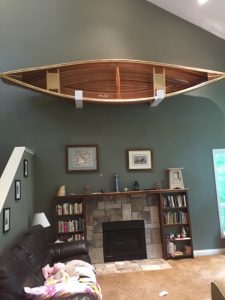
It’s only about 40 pounds, so it’s easy to get in and out of the house and onto and off of the station wagon. And it’s extremely stable in the water and smooth to ride in.
There’s one part of the building process I did want to reflect on. It has to do with control and foresight. I value both of those things, in woodworking and in other areas of life. I work hard to get my right angles to be 90-point-zero degrees, thankyouverymuch. And a measure of foresight is necessary. You want to stay open minded about how a project is going and should go, but you do need to have some idea of the final product you’re pushing toward.
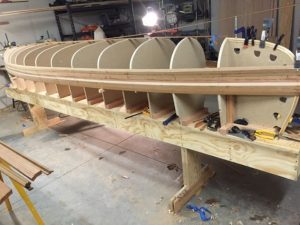
It was an uncomfortable experience, in some ways, to build this canoe because control and foresight were minimized. Here’s an example. You build the canoe upside down. First you make a long narrow table called a ‘strongback.’ Then you attach some ribs to that, to which thin strips of cedar will be temporarily attached. The photo should give you some idea of how this works. Keep adding strip to strip to strip, and that forms the hull. But you can’t really control the shape of it. It’s more like you discover the shape. The bottom strip as you build it, which is the top one when the canoe is flipped over, is attached at first only in the center. So its two ends flop down a bit on either side. If the wood you’re using is relatively rigid, it won’t flex too much. If the wood is less rigid, it’ll flex more. Moores calls this “letting the boat fair its own line.” In other words, you’re letting the wood tell you how it wants to be. There’s no sense fighting every single strip to be a certain way (i.e., the way you thought it should look), so you might as well just find out right away what you’re working with, and then respond accordingly.
This was at first uncomfortable, and then it became interesting, and then it became powerful. I felt myself thinking of the cedar as having a mind of its own, such that we were partners rather than it the lifeless material and I the ensouled animator seated squarely in the driver’s seat.
In contexts, too, such as those where people must be managed, or a gnarly problem solved, I draw wisdom from this experience of the loss of control, of the limits of my foresight.